

Jadeite
How to Judge Jadeite Quality
The way collectors really assess jade — and how to buy it with confidence.
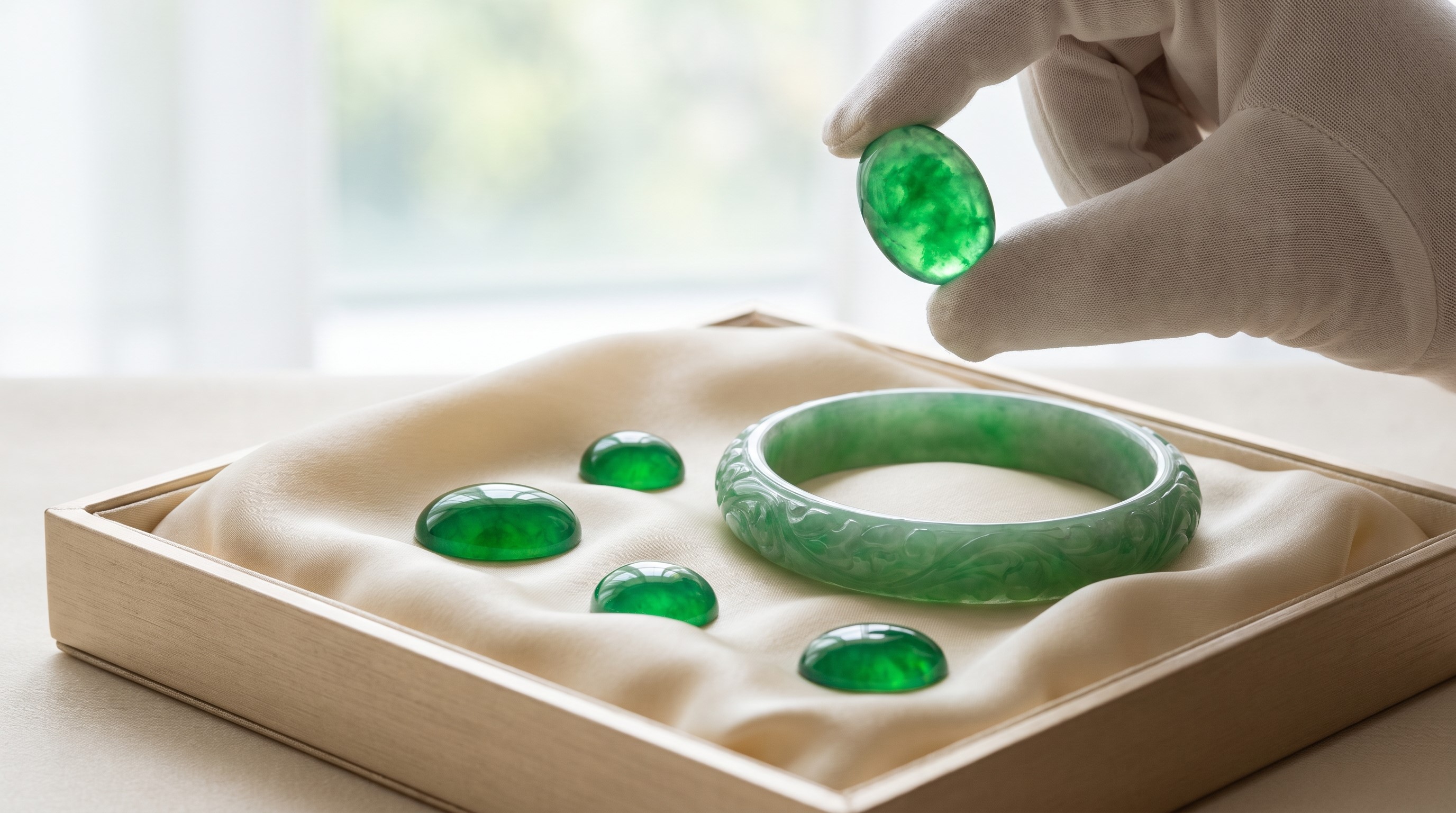
Jadeite is one of the most treasured — and most misunderstood — gemstones in the world. Across Asia it has been prized for centuries as a stone of protection, fortune and family continuity. Yet it's also one of the easiest stones for an untrained buyer to overpay for, because so much of what's sold as "jade" has been chemically treated to imitate the qualities of the finest natural material.
Our family has sourced and graded jadeite since 1965. Here is how we teach clients to look at a stone — the same way we look at it ourselves.
First, the word "jade" means two different stones
"Jade" refers to two distinct minerals: jadeite and nephrite. Nephrite is more common and softer; jadeite is rarer, harder, and the material behind all the world's most valuable jade. When people speak of imperial green jade or investment-grade jade, they mean jadeite. Always confirm which one you're being offered.
The four things that determine value
1. Colour
Colour is the single largest driver of a jadeite's worth. The most prized is a vivid, evenly distributed emerald green known as imperial green. But jadeite also occurs in lavender, red, yellow, icy white and black — some of which command high prices in their own right. What you're judging within any colour is three things: hue (is the green pure, or tinged grey or blue?), saturation (how vivid, not dull), and evenness (is the colour uniform, or blotchy?). Vivid, pure and even always wins.
2. Translucency
Translucency — how much light passes through the stone — is what separates good jade from great jade. The finest jadeite has a watery, glowing quality collectors call "water"; light seems to move inside it. Opaque, chalky material sits at the bottom of the scale, while semi-transparent "glassy" jade sits at the very top. Hold a piece to the light: the more it seems to glow from within, the finer it is.
3. Texture
Texture refers to the fineness of the stone's crystalline structure. The best jadeite has a texture so fine it looks perfectly smooth and feels almost soft to the eye — often described as "old mine" quality. Coarser texture, visible as a slightly grainy surface under light, lowers both beauty and value.
4. Clarity and craftsmanship
Natural inclusions, black spots or fractures reduce value, though some minor natural features are expected and honest. For carved pieces and cabochons, the quality of the cut matters too: a well-proportioned cabochon with a smooth, high dome shows the colour and translucency to their best.
The most important question: Type A, B or C
This is where most buyers are caught out. Jadeite is classified by treatment, and the difference is enormous:
- Type A — natural jadeite, untreated except for a traditional wax polish. Its colour and structure are entirely natural. This is the only jade that holds value and endures. This is what you want.
- Type B — jadeite that has been bleached with acid to remove impurities, then impregnated with polymer resin to restore translucency. It may look beautiful at first but degrades over time — the resin yellows and the surface can crack.
- Type C — jadeite that has been artificially dyed to add or deepen colour. The dye fades, sometimes within a few years.
Type B and C stones can look convincing to the eye — sometimes more vivid than fine natural jade — which is exactly why they're dangerous. A stunning green cabochon at a suspiciously friendly price is very often dyed.
How to protect yourself
- Ask directly whether the stone is Type A, and ask for it in writing.
- Request a certificate from a recognised gemological laboratory for any significant purchase — this is the only definitive proof of Type A.
- Be wary of vivid colour at a low price. Fine natural jade is rare and priced accordingly; if a deal feels too good, it usually is.
- Buy from someone who lets you examine the stone against the light, explains what you're seeing, and welcomes your questions.
Why we grade every piece in front of you
At VANA, every jade piece is assessed against the light, in front of you, with its treatment status stated plainly. We would rather lose a sale than sell you a dyed stone dressed up as an heirloom. Jade is meant to be passed down — and only Type A jade is worthy of that journey.

About the author
Wayne Lau is a third-generation jeweller and co-founder of VANA Fine Jewellery in Ampang, Kuala Lumpur. He learned stones at his grandmother's wholesale bench in Taiping, and now advises clients privately alongside his wife and co-founder, Emily Tan. Every guide in this Journal is written from what happens at the consultation table — nothing else.
See Jade the Honest Way
Bring a piece you own, or come to choose a new one. We'll show you exactly what you're looking at — no pressure, ever.
Ask About Jadeite